Wednesday, March 27, 2024

The Little Boy with a Big Name

 
Last night I bumped into a neighbour in the stairwell. Roy is a very sweet, young man in his late 20s. He is modern orthodox. Despite his exhaustion, we stopped to chat. 
 
His wife had given birth to their first child, a little boy, on October 4, 2023. This was three days before the Hamas attack.
 
“We named him Ivri”, he told me proudly. 
The name means ‘Hebrew’; as in, a person of the Hebrew nation. I was moved.

“How timely!” I responded.

“Yes. We named him because of the Hamas attack, to represent his strong position as a member of our people. His middle name is Ben-Zion”.  

This name also has a strong meaning; son of Zion; a member of the Jewish people who are domiciled in the land of Israel.

 “Did you make it to the Brit Mila (circumcision), or were you stuck in the army?”.

The Brit Mila is when the baby would be officially named, and it would have taken place on October 12. He smiled ever so slightly at my question, but then showed a serious expression.

“When Hamas attacked on October 7, I had just been discharged from the army, and I was immediately called back. I spent the first 3 days of the war with my unit fighting Hamas inside Israel. They were heavily armed fighters, and the battles were intense. Some were in kibbutzim that had been invaded. Believe me, I saw things that will stay with me for life.”

Https://www.haaretz.com/israel-news/2024-01-26/ty-article/.premium/on-eve-of-discharge-israeli-soldiers-talk-combat-hostages-and-why-they-went-into-gaza/0000018d-421a-dc44-a5bf-cabedf330000

https://www.timesofisrael.com/idf-82-of-soldiers-treated-for-mental-health-since-oct-7-are-returning-to-duty/

 “After three days, we began preparing to cross the border into Gaza. My commander gave me a few hours off to come home to Jerusalem for my son’s Brit Milah, but I returned straight afterwards.”

Another pause.

 “My wife and I deliberated whether to name our son after a friend who’d fallen in those first three days, but the unfolding tragedy was so great that we went with a name with a wider reference.”

https://www.timesofisrael.com/baby-names-appear-to-see-influence-from-october-7-attacks/

“For better, and for worse, being Jewish is a struggle. So far I’ve served in Gaza for three months. It was awful. I really wondered what sort of world I’m bringing my son into. But that’s our lot, and we have to live with it. All we can do is try to make the world a better place. My great-grandfather fought in the War of Independence, my grandfather fought in the Yom Kippur War, my father fought in the Lebanon War, and I’ve already fought twice in Gaza. Will my son need to fight? Probably. The better I make the situation now, the easier it will hopefully be for him. Bringing a child into the world changes your perspective on life and how you want things to be. It’s all so difficult and so fundamental.”

 He smiled again, wondering if he had shared too much.

“Anyway, that’s how I see things.”

I hugged him farewell and went home to my flat.


Nuts Up North

At home, I made myself a cup of tea and switched on the radio. An evacuee from a town in the country’s north, close to the border with Lebanon, was being interviewed. I put up the volume.

“It’s nuts. Everyone talks about Gaza and the south, but we’re also at war with Hezbollah in the north. They shot fifty missiles at us today. Fifty! Our town was evacuated months ago because of the daily missiles and RPG attacks from across the border, and my family’s been relocated to a hotel further south. We left home six months ago, and we have no idea when we will be able to move back.”

The radio interviewer expressed understanding before the gentleman continued describing his life.

“The conflict with Lebanon is going to heat up, and there’s no end in sight. Think about this; I just bought a full-size fridge and stove for our hotel room, so that my wife can at least cook properly. For our hotel room!”

https://www.shomrim.news/eng/hotel-warphobia

https://www.jpost.com/business-and-innovation/all-news/article-788760

https://www.mevaker.gov.il/En/publication/Articles/Pages/2023.11.07-Mevaker-EN.aspx

https://www.taubcenter.org.il/en/pr/uprooted-in-their-own-country/

The speaker was impassioned, and the interviewer clarified a few points. But his tale of woe continued.

“In my village I raise chickens and market the eggs. That means that every day I have to drive all the way back to our ghost town, in the firing line, to tend to the chickens and collect the eggs. My kids beg me not to go. And to top it all off, I am barely scraping together a living.”

 The interviewer cut in. “Why don’t you just pack it in? Give up the business?”

The poor fellow raised his voice and replied at fever pitch.

 “I’d love to! But I have a contract with the government that I can’t get out of easily and, if I do, then I won’t have any income at all.”

 Other concerns were raised during the broadcast. Hotels and tourist businesses up north are closed. People aren’t visiting, even in areas that have not been evacuated. Little if any compensation is in place for those suffering loss of income. Many evacuated families have come from villages with a strong sense of community, but which have now been disbanded. Having moved to hotels, some evacuees have relocated to other hotels or rented flats, sometimes having moved a few times. Some of the hotels have kicked them out because the Government failed to pay the bills. Families are now deliberating where to register their children for the new school year.

 The Gaza campaign is grueling, and the soldiers need to be rotated and given time to go back to their lives, both for psychological reasons, and so that their personal lives are not overly impacted (read: damaged) by their absence from home and work.


Sharing the Burden

 There is a serious shortage of soldiers. Resentment has resurged against military exemptions given to ultra-orthodox men so they can study Torah. Religious elements of the current government are pushing to raise the age of exemption, so that more people can avoid service. They claim that Torah study is an important element in the spiritual health of the nation, and study and prayer successfully beseech God to support Israel in its challenges.

 During the Lebanon War, I attended a military Yeshiva in Jerusalem as a foreign student. I was young and naive. One day at breakfast, I sat with my Israeli study partners - all soldiers - and extolled the beauty of the world overseas. One fellow sat quietly. "Have you ever travelled outside Israel?” I asked. He looked back at me with cold eyes.

 “Yes” he answered. “Lebanon.”

It took me a minute to realise he had, in fact, seen Lebanon, from the inside of a tank.

 Some time later, I visited family living in the Jerusalem hills. I waited on the side of the hot, dusty, mountain road for a bus to take me back to the Yeshiva. An old lady, a local, joined me. “Is this the bus stop? I’m on my way to Jerusalem, back to my yeshiva.”

The woman looked me up and down for a moment before screaming. “How dare you? Living as parasites off everyone else! You Haredim are all the same!” I had been taught to be proud of being studying Torah, and I was oblivious to the controversy surrounding Haredim, Yeshiva subsidies and military exemptions. My attacker berated me for ten minutes and I honestly didn’t understand why and was horrified.

 Now, decades later, I get it. It’s called sharing the burden.

 Is it cynical to suggest that, if boards of inquiry are established to examine the military and intelligence failures that led to the October 7 massacres, then they should also examine why Haredim, exempted from service, failed to protect the nation through Torah study as promised.

https://youtube.com/shorts/K0fNPN6SP8k?feature=share

 This question, posed in the above video, comes on the heels of an extremely controversial comedy sketch that portrayed the ultra-orthodox as draft dodgers. That video seems to have been taken down from youtube, but responses to it are openly available.

https://www.youtube.com/watch?v=sydVsPJoPv8

https://www.youtube.com/watch?v=u4Q63sqGqP4

 I should make clear that many ultra-orthodox do proudly and effectively serve in the IDF.

https://en.idi.org.il/articles/51166

 The legislation allowing for Haredi military exemptions is expiring. A new amended bill is being discussed, that will gradually increase Haredi involvement in the IDF. Whether serving the country in the military or in some other capacity, logic - and the principle of equality - dictates that every citizen should share civic burdens. Some government members have threatened to resign and bring down the coalition if the amended bill increasing Haredi seervice is not passed. More politics. Yada yada yada.

https://www.merriam-webster.com/dictionary/yada%20yada#:~:text=%CB%88y%C3%A4%2Dd%C9%99%2D%CB%88y%C3%A4%2Dd%C9%99%2D%CB%88y%C3%A4%2Dd%C9%99,predictable%20to%20be%20worth%20repeating


 Purim Redux

 This past weekend, the Jewish world celebrated Purim. The fast of Esther - the anniversary of when the Jewish queen fasted to enlist God’s help to overcome the decree to kill the Jews of Persia - fell on Thursday. I was volunteering at the Community Gardens on that day and found a religious member of our group sitting nervously in the clubhouse. She looked up at me.

 “At 4pm today, Israel time, Jews around the world are going to say the ‘Shema Yisrael’ for the release of the hostages held by Hamas. Can you help me get people to join us?” Others in earshot displayed apathy at her remark and I saw no point in pushing them. When 4pm approached, I accompanied my friend outside to a private spot. Others from the clubhouse, secular in appearance, suddenly joined us to be part of the enterprise, and we all said the Shema Yisrael together.

Let’s see if it helps.

https://www.globalestherfast.com/

https://www.ynetnews.com/article/sjcrm00tcp

 This morning, after leaving my Pilates class, I took the elevator down to the street. It stopped on the floor below. As the doors opened a large man peered in to see if there was room. “Going down?” he asked.

“I saved some space for you!” I said with a welcoming smile and ushered him in. He entered and stood next to me.

“It’s a good thing you did. I’m pretty heavy, so you know we are definitely going down.” I laughed.

“Incredible, I’ve been stuck here for a month waiting for someone big to turn up and bring the elevator down to the ground.”

We both giggled.

“Thank you," he said to me. "It’s good to laugh. Everything’s falling apart in the country. At least we can still laugh. Stay safe.”


That’s the view from here.


Tuesday, March 12, 2024

The Day After


Many have been asking who will run Gaza after the current war between Israel and Hamas has ended.


Will it be occupied by Israel, temporarily or otherwise? After all, there was good reason for Israel to totally withdraw from Gaza in 2005 (see the second part of this post below).

https://foreignpolicy.com/2023/12/06/israel-gaza-reoccupation-military-post-hamas-war-plans/

https://edition.cnn.com/2024/02/23/middleeast/netanyahu-unveils-future-post-hamas-gaza-plan-mime-intl/index.html


Will Hamas remain undefeated as the government of Gaza, possibly after a release of Israelis it is holding hostage, thereby retaining control over a population that it treats as a means to the destruction of Israel, and whom it has brainwashed accordingly?


Will it be the Palestinian Authority, which, in 2006, lost elections in Gaza to Hamas, before it was totally ejected in a bloody coup in 2007 ?

https://en.wikipedia.org/wiki/Battle_of_Gaza_(2007)

https://www.washingtonpost.com/world/2023/10/24/gaza-election-hamas-2006-palestine-israel/


Will it be the Egyptians, who annexed Gaza in the 1948 war, after the British relinquished their mandate, and who were repelled by Israel in the 1967 war? Paradoxically, Israel wanted to return Gaza to the Egyptians in exchange for a peace treaty but the latter refused, knowing that a state of war with Israel was preferable to controlling the population of Gaza.

https://en.wikipedia.org/wiki/Occupation_of_the_Gaza_Strip_by_the_United_Arab_Republic


Will it be an ‘independent’ entity such as the United Nations, which, for the last few decades, has held the mandate of maintaining the social, educational and financial infrastructure of Gazan society through the UNWRA?

The facts on the ground would not support this as a viable option: 75 years on from its establishment, the Gazan population remains in poverty, UNWRA institutions have colluded with terrorists (Hamas & others) to create a launching pad for the murder of Israelis and the destruction of Israel.

https://www.fdd.org/analysis/2024/01/30/unrwa-exposed/


Will it be the Hamulas – family clans – that currently control various cities in Gaza, and who are trying to impose civil control in the vacuums created by Israel’s ouster of Hamas in northern Gaza? An arrangement wherein these clans coordinate to rule Gaza is considered by some to be an option worth considering. Except for the fact that each of these clans is in competition with the others, and is closely tied to one of the numerous terrorist groups on the Strip. (The second article in the link below was published in 2007, soon after Hamas took control of Gaza.)

https://www.jpost.com/israel-hamas-war/article-790084

https://www.crisisgroup.org/middle-east-north-africa/eastern-mediterranean/israelpalestine/inside-gaza-challenge-clans-and-families


Will it be a multinational force including moderate Arab countries, working together, to once and for all solve the outstanding issue of Palestinian statehood, a cause celbre against Israel that Arab countries fostered for so that it’s now biting them in the bum - primarily because they want to cash in on Israel’s success as a global financial and social powerhouse, but they can’t while that pesky Palestine issue won’t go away?

https://www.timesofisrael.com/gallants-post-war-gaza-plan-palestinians-to-run-civil-affairs-with-global-task-force/

https://www.foreignaffairs.com/middle-east/why-arab-states-must-lead-gaza


Other options are being canvassed.


Permit me to share a short personal anecdote that may provide nuance to the questions above.


About 30 years ago, when I was involved in Jerusalem’s religious singles’ scene, I attended a ‘lonely hearts’ weekend. It was held at a kosher hotel in Neve Dekalim, a sweet little Israeli settlement in Gaza, on the Mediterranean coast. Apart from a quick stop in the town of Rafah during a bus trip to Cairo more than a decade earlier, it was the only time I had been to Gaza. The hotel was comfortable and the sea looked inviting. Most people attending the weekend event were more focused on celebrating the Shabbat and looking each other up and down than exploring the area, so they didn’t leave the hotel compound.


In the course of dinner on Friday night, I struck up a conversation with a nice religious woman visiting from New York, and we decided to wander out to the beach in the moonlight. We flirted as we walked, partly taking in our surroundings, calm in the knowledge that the army was stationed all around to protect us. That short walk was all I got to experience of Neve Dekalim, ultimately a brief flirt of no consequence.


When our group checked out of the hotel and left for home on Saturday night, I was sad that I hadn’t had a chance to see the area a little. Sitting next to me on the bus was our Melave Neshek (military escort), a young fellow my age who had joined our activities but served as a private security detail. Such escorts are common for group activities in Israel. He peered out of the bus window as we drove along, passing a series of unpaved car tracks that turned off the sandy road.


“Do you see those tracks?” the escort asked me.

I did, and I told him so. I expected him to tell me about a great hike he had done in the area.

“Each one of those leads to trouble.” I didn’t quite understand.

“What do you mean? Is the road too difficult to drive on because of the sand?”

He turned and looked straight at me.

“Trouble. Arabs. Our soldiers serving in this area hate going off the main roads. It’s so dangerous!”


His words gave me a context I had not expected, and which found refuge in my mind. I never again had a desire to visit Gaza, and whenever I heard on the news that another soldier had been killed securing the settlements, I began to wrestle with the importance of maintaining a Jewish community in Gaza.


More stories next time…


Wednesday, February 28, 2024

ANGST AS ART


Ultimately, it had to find a way out. 


The angst and melancholy simmering in every Israeli’s chest since October 7 has been finding numerous forms of release. While I suspect people have been less productive at work - (I know I have been) – angst has proliferated in the form of art.


Angst-based Comedy 


Brave stand-up comedians have been impressive in their portrayal of daily life in the shadow of the  Hamas massacre and ongoing terrorist attacks in our cities. Comedians include Israeli Arab Muslims, performing in Hebrew.


Each of these shows manages to beautifully - and in a strange way, comfortably - depict what we are all experiencing. The material includes: vignettes of Arab citizens in a Jewish country under attack by other Arabs; struggles with life in a hotel after fleeing home due to rocket attacks; life as a soldier; the fear felt by tourists when they order a taxi and a car, resembling vehicles used by the murderers in the October attacks, turns up with an Arab driver; and more.


TV comedy shows, such as Eretz Nehederet, have been prominent in this effort. One episode, performed in English, highlighted the blatant anti-Israel agenda inherent in BBC news reports

Amazingly, this was picked up by media analysts overseas and stimulated conversation about BBC impartiality.


Other comedy sketches cover everything from UNRWA's complicity with Hamas, to antisemitism at American University campuses. 


Memes


The Internet has been rife with sarcastic cartoons that manifest the craziness of Israel's current affairs. When feeling aggrieved by fake news, posting an image of the type below can be very satisfying.


Trauma in Art


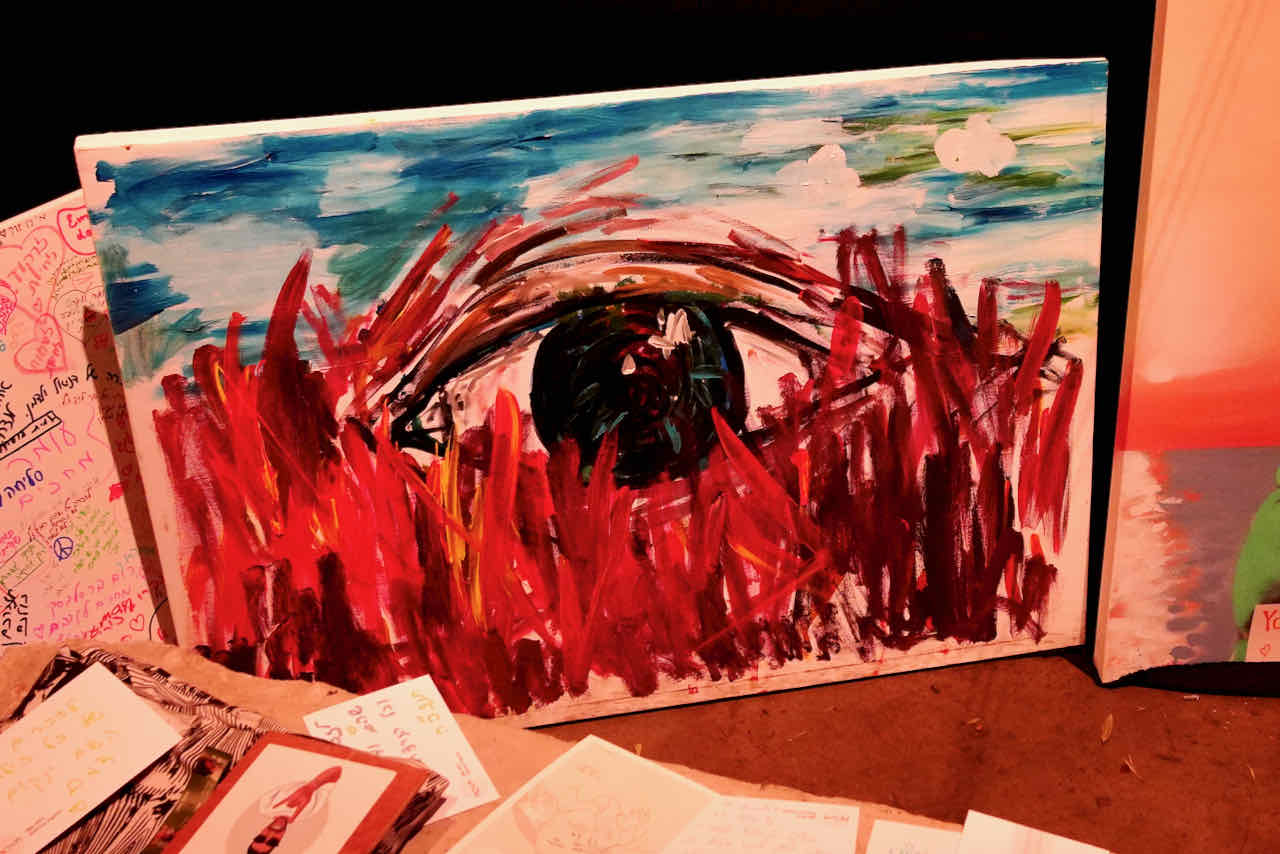
In a previous post, I wrote about an exhibit depicting the Nova music festival massacre.

On display soon after the attack took place, paintings by survivors successfully instilled the intensity of their trauma. (see photos in that post).


Baby on Board 
 
While the streets here have been plastered with posters bearing pictures of the hostages held by Hamas, as well as signs of all sizes declaring ‘Together We Will Win’, more nuanced messages have started making appearances.

A company is now selling yellow signs for your car's rear windshield. The words ‘Baby on Board’ have been replaced with ‘Baby in Gaza’. While only a small act of defiance against apathy, displaying such a sign is a public declaration that proudly states: I am with you and we are all in this together.


Blogs


Sharing and connectedness are a powerful panacea for anxiety and stress. This probably explains the blooming industry of blogs that allows people to express their thoughts and concerns about the quandaries we are living with today. I guess I'm part of that industry. Writing my blog gives me a sense of purpose and a feeling of contribution, while also leaving, for future reference, a testimony of Jewish and Israeli life today.


Poetry 


Poetry is another specialised artistic field that lends itself perfectly to memorialising our current experience. Large billboards posted outside the President's house contain a poem (in three languages), along with photographs, that describe an art gallery in Kibbutz Beeri that was destroyed by the terrorists in their rampage. 


Graffiti
 

Graffiti is the perfect medium to scream blue murder in a public forum.

In Jerusalem, crude graffiti has turned up on walls cursing Bibi with crass language. This may, of course, all be the work of one individual. Either way, when found, the municipality messily paints over them to render the text illegible.

Painted on a wall in town were the words ‘Bibi=Hamas’. Someone later crossed out the word Hamas and replaced it with ‘King’.


Public Participation


The Djanogly Visual Arts Center in Jerusalem runs workshops for the public. I was alerted to the Center's current exhibit by my friend Yonit Rosen, and I was so pleased to find it. Artists were invited to celebrate heroines of the war: women unwittingly thrust into situations of adversity, and their courage and ingenuity in saving lives.  
 
The experiences that inspired the displays are surreal. 
 

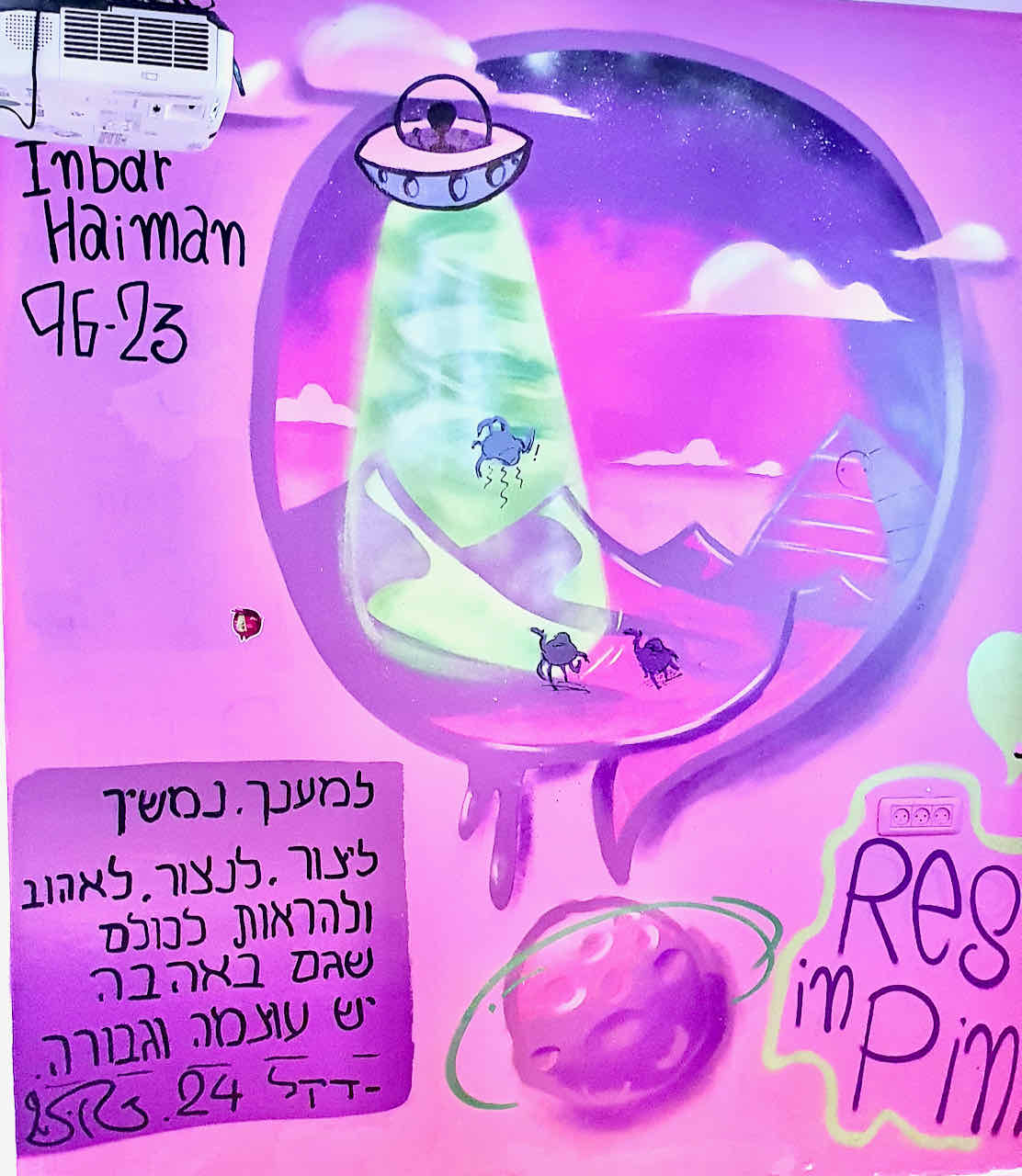
One room at the Center is dedicated to young graffiti artist Inbar Haiman. Known in the art world as 'Pink’, she was kidnapped by Hamas and held captive in Gaza. 

Family and friends held a campaign for her release. 


Sadly, in late October, her family was notified that Hamas killed her in captivity. 


Inbar was an attractive young college student. She was kidnapped as leverage in negotiations with Israel. She was held by Hamas, which is known for its murderous sexual assault of its victims. The fact that Inbar did not survive leads me to wonder whether her value to Hamas as a bargaining chip was lower than as a sexual victim. What did she suffer? My stomach turns. 


The words, Rest in Pink, together with an emotional message by another young artist who had never met her, were subsequently added to the exhibit.


Each wall in the building was made available to artists. Some painted directly on the plaster walls, while others prepared posters and other works that will auctioned off after the exhibition is closed. The proceeds will be donated to damaged communities of the Gaza envelope. 
 

Female Warrior
 
Aged 25, Inbar Leiberman, of the Kibbutz Nir Am first-response security team, felt something wasn’t right on the morning of October 7. Alerting other members of her team, Inbar took the initiative and directed operations. Inbar and her team fought off numerous Hamas attackers, saving her kibbutz. She is sexily portrayed on the wall with sass and style.


The Cookie Monster


When Hamas terrorists barged through the door of 65 year old Rachel Edri and her husband, she knew her only defense against being murdered was time. Unbelievably, Rachel convinced her attackers to let her bake them fresh cookies and take care of them. Somehow, miraculously, her ploy worked for almost 20 hours, during which time she and her husband were held at gunpoint. It gave her policeman son the time to summon an armed team to come and save his parents.

https://www.businesstoday.in/latest/world/story/israel-hamas-war-how-a-65-yr-old-israeli-grandma-tricked-hamas-militants-with-tea-moroccan-cookies-402534-2023-10-19


Daring Droppings

Probably the most poignant display at the art center is that of numerous little twirled plaster statues. I looked at them curiously, At first I thought they looked like ice-cream Sundays. But then again, they could have been piles of feces. Visitors are invited to paint them in a variety of colours. I spoke to the curator who gave me a tour. We arrived at the table of statues. 


‘These really describe public sentiment.”
 
“Are these what I think they are?” I asked.
 
“These are called Happy Shit”. The curator and I both smirked for a moment, knowingly. It was a moment of shared absurdity. But I suspect that inside, each of us was crying just a little bit. 


Among Friends


Rivkah Blok, a highly talented young woman in her early twenties (whom I have known since she was born) epitomised the state of the nation, in an image she crafted so well and shared on social media. 


Every time I look at it I feel a sad stillness. A need to take stock. Connection. Responsibility, and perhaps responsibility that has been disappointed. As with the figure in the image, I too feel a need to sit still for a moment and cry.


And that, my friends, is the power of art.


Thursday, February 22, 2024

Nature, Nurture, and PTSD


The Dwindling Hostage Count

I was recently invited to join friends for dinner. On entering their living room I saw a poster on one of the armchairs. It contained the image of Uriel Baruch, a young Israeli man taken hostage by Hamas.
https://forward.com/forward-newsletters/looking-forward/569286/there-are-240-hostages-in-gaza-one-is-uriel-baruch/


“Have you met Uriel?” I was asked. I looked at the poster and then for somewhere to sit. “Oh, please sit in the armchair - Uriel's happy to make room for you.” The poster was moved to a kitchen chair. Behind me was a flame burning in a 7-day candle. I looked at my host inquisitively. “A candle will stay burning until all the hostages come home,” I was told with a stern look. “They are always with us”. 

Following a deal in November, which saw about a third of the hostages released by Hamas, 136 Israelis have remained in captivity. They remain in the minds of most people in Israel and Jews globally. Bring Them Home has been a rallying cry throughout the country.

https://m.facebook.com/StandWithUs/videos/136-hostages-are-still-in-the-captivity-of-genocidal-hamas-terrorists-in-gaza-du/236227396223208/


Hersh Goldberg is one of those still held.

https://nypost.com/2023/10/24/news/horrifying-footage-shows-hersh-goldberg-polin-moments-after-arm-was-blown-off-by-hamas/


A few weeks ago I walked past his parents’ home in Jerusalem. Their balcony is adorned with an enormous number, for all in the neighbourhood to see, representing the number of days he's been in captivity. Each morning his mother updates the number. After 100 days had passed, his parents requested that people wear this number as a badge on their clothing. “We cannot forget them”. At an engagement party I went to last week, many of the guests wore this badge of honour. Before making a celebratory speech to his friends, the groom began with one moment of silence for the captives and the soldiers looking for them in Gaza, and made a prayer for their safety.


On February 6 it was announced that approximately 32 of the remaining hostages were known to have perished. 

https://www.nytimes.com/2024/02/06/world/middleeast/israel-gaza-hostages-dead.html

This news only serves to increase the anxiety of Israelis who know that the longer they remain in captive conditions the lower their chances of survival, and time is running out.

https://www.cbsnews.com/newyork/news/hourglass-in-times-square-represents-time-running-out-for-israeli-hostages/

This became even more poignant (if that were possible) after evidence - both testimony and forensic evidence - started coming out of the sexual abuse and assault of girls and women in Hamas captivity.

https://www.theguardian.com/world/2024/jan/18/evidence-points-to-systematic-use-of-rape-by-hamas-in-7-october-attacks

https://www.usatoday.com/story/news/world/2023/12/20/hamas-sexual-violence-rape-hostages-oct-7/71917113007/

Note that three films are currently in production on this issue.

 https://www.msn.com/en-ca/news/world/sheryl-sandberg-unveils-oct-7-film-about-hamas-s-sexual-atrocities/ar-BB1hXj35

The implications of all this are horrific. Everyone here is sick to the stomach from what is going on, and is partially paralysed by a feeling of helplessness. Protests are increasing in intensity for the Government to ‘bring the hostages home’ by any means.

https://www.washingtonpost.com/world/2024/02/17/hostage-family-protest-israel-netanyahu/

Politicians (you know who I mean) are accused of making strategic decisions based on self-interest, at the expense of reaching a deal facilitating the release of the hostages; assuming, of course, that such a deal is possible.

https://edition.cnn.com/2024/02/17/middleeast/hamas-hostage-deal-demands-delusional-israel-intl/index.html

None of this is helped, of course, by the fact that the radio news here is aired with music in the background, which increases in intensity as each item is read out by the broadcaster. Many have taken to only looking at the print media, or foregoing the news altogether.

To relieve my anxiety from the stream of news I focus on my budgies, Dov Ber and Chaya Mushka. They have also experienced a little stress lately, so I spent a week building them a larger aviary, and then some toys to play with. With radio interviews blaring in the background, the birds chirp loudly as if to drown out the constant hum of awful information.


I even went to buy them a treat. “I’ve got one packet of budgie treats left,” said the pet store owner, reaching up to the shelf, “but it’s past its use-by date. You can have it for free.” I thanked him and looked at the date marked on the packet. 7-10-23. A chill went down my spine.

In early February, newly elected Argentine President Javier Milei visited Israel. A colourful character, he has announced his intention to convert to Judaism.

https://www.jta.org/2024/02/06/global/argentinas-new-president-javier-milei-heads-to-israel-on-his-first-overseas-diplomatic-trip

During his visit, the Argentine President was taken to the Western Wall where, with tears in his eyes, he  prayed for the welfare and release of hostages held by Hamas.
https://www.youtube.com/watch?v=96pybR_stUM

Days later, on February 12, the Israeli military announced that two hostages, held captive in Rafah, had been rescued in a special operation by the IDF. Both hostages were of Argentinian descent.

https://www.washingtonpost.com/world/2024/02/12/israel-hostage-rescue-rafah/

This was a major coup for the military and for the government, and everyone in the country felt a surge of excitement. But the feeling didn’t last long. It did not lead to a slew of hostages being saved. On the contrary; Hamas is more wary than ever of such operations, and concern for the remaining hostages' safety has grown significantly.


Facts on the Ground


Almost all Israeli media reports since October 7 have focused on the Hamas attack and its aftermath. Video footage filmed by Hamas fighters, Israeli soldiers, dog-mounted cameras from the army’s canine unit and aerial photography have all been aired. Released captives have spoken about the conditions they endured in Gaza, whether in the custody of hostile Gazan families, in deep underground tunnels, or in dedicated secure areas in Gazan hospitals.

https://www.msn.com/en-us/news/world/israeli-forces-storm-main-hospital-in-southern-gaza-saying-hostages-may-have-been-held-there/ar-BB1iiVLW


As Israel’s mission in Gaza proceeded, much material was collected that provided significant information. This has included clues about the hostages, their conditions and whereabouts. The sources of data are varied: interrogation of Hamas fighters who have surrendered, abandoned Hamas computers (with files of prisoner lists, sentry lists, fighter lists, battalion details, battle strategies and instructions, etc.), security camera footage from the tunnels, and more.

https://www.reuters.com/world/middle-east/israeli-military-says-weapons-found-al-shifa-hospital-2023-11-15/


Amongst other things, an Israeli car stolen by Hamas during its massacre of Israeli citizens was found by troops in the Nasser Hospital parking lot in Gaza. This, despite claims that hospitals are humanitarian safe zones and not used by terrorists.

https://www.msn.com/en-us/news/world/vehicles-stolen-from-israel-unopened-medicine-for-hostages-found-at-nasser-hospital-says-idf/ar-BB1itBtN


And let’s not forget the plethora of children’s books found in the bedrooms of regular Gazan homes. Below are photos I took of a report shown on Israeli TV showing pages from a variety of children’s books found by soldiers, glorifying attacks on Jews.


For more details, listen to the following interview with a man who grew up in Gaza and escaped its culture of death against Jews. He came to Israel to verify what he had been taught and to see Jews for himself. This led him to convert to Judaism. As distinct from Jewish boys - who are circumcised with the blessing that they should be raised to observe Jewish law, get married, and do good deeds - Gazan newborns are paraded with a knife beside them in the hope that they will grow up to kill Jews. According to him, the culture of murdering Jews is so pervasive that there are no innocent civilians in Gaza. Anyone who disagrees with the genocide of Jews has long ago been either executed as a collaborator with Israel, or has moved overseas.

https://youtu.be/qbCuOSSc9j0?si=sClD3U9scLubgcEY


Conflicting Terms of Reference


A fundamental driver of anti-Israel opinion is the misunderstanding of occupation. Protaganists have a sense that the Hamas massacre of innocent Israeli civilians (both Jewish and Arab) was justified resistance to Israel’s purported ‘occupation’ of Arab land.

Western well-wishers believe that hostilities will end when the occupied territories - evidently something Jews stole from Arabs - are returned. (Note that a new expression - Jewed - which I first heard in Australia, refers to unfairly taking property that belongs to another.) These well-wishers have no idea if these occupied territories mean Gaza, Judea, the West Bank, Samaria (yes, I know it’s the same thing), Palestine (whatever that is), and pretty much everything from the river to the sea. In the same breath they declare that Israel can stay where it is. After all a 2 state solution sounds fair, doesn’t it? 

By contrast, the Arabs have a clear agenda. Israel and the Jews must go. Everything from the river to the sea - i.e.: the West Bank, Gaza and the entire State of Israel - is occupied and must become an Arab state called Palestine.

To them it is not relevant that the West Bank is governed by the elected Palestinian Authority and Gaza by its elected government Hamas, except insofar as these two bodies are the leading crusaders for the destrucion of Israel. Nor is it considered relevant that much of British Palestine was given over by the British to the Hashemite tribe for the creation of the country Transjordan (today known as Jordan). Imagine if the British had had the foresight to name it Arab Palestine...

Israel sees itself as a country with western values, while also understanding what the Arab Palestinians mean when they talk.

But as long as there are such conflicting terms of reference, and the West allows anti-Semitic undertones to blind its agenda, Israel will be abused by both the East and the West.


Genocide


Much of the international media spins the Israel-Hamas conflict in the most ridiculous terms. The accusation of genocide has been bandied about so much that, in my opinion, it has lost most of its meaning.

https://www.huffpost.com/entry/brazil-lula-israel-gaza-genocide-holocaust_n_65d2913be4b0ce1bdc39fc2e


Israel has been bashed, and battered, and even dragged to the International Court on accusations of - you guessed it - genocide.

https://www.npr.org/2024/01/26/1227078791/icj-israel-genocide-gaza-palestinians-south-africa


When Brazil’s president Lula de Silva (see the link above) accused Israel of genocide, he was driven by anti-Semitism. How so? By wilfully mis-framing Israel’s operations in Gaza as retaliation for the initial Hamas attack, and not as a defensive action preventing future attacks that have been promised by Hamas, de Silva wrongly portrayed Israel as motivated by genocidal intent. The same is true for South Africa and others.

For the sake of broad-mindedness, I follow a variety of news services, including those hostile to Israel. The latter all have one thing in common: a misunderstanding of facts and how they work. Sometimes my head spins as I try to untangle the confused logic they spew. And each time I’m dumbfounded by the credence given to them. As it turns out, I am the stupid one for thinking that most people think logically and critically consider the veracity of things they are told. 

In these news services the main character of our story - Hamas - is either mentioned only in passing or not at all, and is generally not deemed relevant of judgement, even when that group openly states it will continue to carry out similar massacres on Israeli citizens in the future.

https://nypost.com/2023/11/01/news/hamas-official-vows-to-repeat-israel-attacks-again-and-again-until-its-destroyed/


Nature, Nurture, and PTSD


With climate change bringing us a warmer winter than usual, I was pleased when a week of stormy weather hit our shores. These days the nightly forecast includes weather conditions expected in Gaza and the Hermon, for the benefit of any soldiers serving who are listening. I thought of our soldiers, sloshing around in the Gazan mud, unable to change their clothes for days at a time.

On hearing the forecast, I took the opportunity to go flood-hunting in the desert and hopefully clear my head. 

My windscreen wipers screeched rhythmically as I turned towards the desert, and the dark sky suddenly cleared. Within minutes I was heading south towards the Dead Sea, past the long suburbs of East Jerusalem on the ridge above me. Bedouin encampments replaced them as the hilly slopes became more barren. At sea level, I stopped off to visit my friend Ahmed, who gives camel rides to passing tourists. We stood in the winter sunshine shooting the breeze, and I thought of the constant accusations of apartheid leveled at Israel. Why don’t people come here to see for themselves?


I continued to the Dead Sea and turned south along its coastline. Radio reception was weak, but I could still make out a discussion on the main channel. The mother of a deceased soldier wanted to become a grandmother. She had posthumously had her son’s sperm harvested and frozen. Together with other grieving mothers, she had petitioned the authorities to clear the way for artificial insemination. The Knesset Health Committee has approved the process, for which legislation is now being prepared. While this has been available in Israel until now for widows who lost their partners, not so when the request came from the deceased’s parents.

https://www.jpost.com/israel-news/article-780309#google_vignette

A few kilometres past Qumran I turned off the road and parked under the massive rocky cliffs of the Judean desert. A fast-flowing river, normally dry, rushed seaward. The rocky ground crunched underfoot as I followed the river, which carried the day’s rainfall from Jerusalem. In the distance, a thundering waterfall, with 3 levels, poured down the side of a cliff.


Two young men, returning along the valley to their car, walked towards me. One held a baby, the other an M16 rifle. We greeted each other and started chatting. Childhood friends, they had both just been released from serving in Gaza and came out to the desert for a break. “I come here to see the waterfall every winter,” said the one with an enormous, soft smile. His rifle dangled behind his back and he readjusted the strap across his chest.

We cooed at the sweet baby held by the other.

“Do you have any other kids?” I asked.

“Four others” he replied. I was taken aback. He must be older than I expected and was probably a reservist.


“How long were you in Gaza?” I asked.

“Four months” replied the father. He saw the expression on my face. “Yes, it was a long stint. I actually got out last week.”

“Wow! Have you managed to sleep yet, or are the kids hanging onto you all the time?”

He laughed. “Something like that.”

“Are you back at work? Is your job okay?” I have heard stories of reservists returning after long periods of military service, but their employers had needed to hire someone else when they were away fighting.

“I’m fine. At least now my wife can work while I take care of the kids. Beforehand she didn’t have any free time and couldn’t work properly.”

The implications of this war are so diverse and not discussed, especially abroad.

I didn’t want to ask him what he did during his four months, or what battalion he was in. Nonetheless, he told me of a few of the places he had served. Most of the Strip.

Gesturing towards the gorge and the river, I said “It must be surreal coming here after fighting in Gaza. Like being on a different planet. Good on you for keeping your sanity while experiencing the dissonance. I am always amazed how Israeli soldiers do their duty but, on returning, never discuss what they have seen and experienced.” He nodded in agreement.

“We are out there doing our thing so that the citizens of Israel can get on with their lives. We all have a part to play. Yours is to keep the country going. Otherwise there’s no point to what we are doing.”

His words were powerful. 

I wished the two friends well and went on my way.

Later, I drove out to the shores of the Dead Sea to see some desert wildflowers. 


The spot was secluded except for a rented caravan beside a swinging bench on a cliff, overlooking the blue water of the sea. In the distance, the mountains of Edom shone in the late afternoon sun. A young man sat silently in a chair by the caravan. Having returned from service in Gaza, he had sought somewhere to be alone and rented this spot from a local. It seemed perfect.


I could only imagine the tumultuous experiences in his head: explosions, bullets, heat, the barking of orders, constant tension making his pulse a deafening clamour, distinguishing between little boys running into his gunsights as they searched for their mothers, and others running into his gunsights as they lobbed grenades at him. And he would shoot, shoot, shoot, the bullets exploding beside his ear as the casings popped out of the rifle in succession.

As I have said, I can only imagine. But whatever the case, the still, quiet, desert air - silent apart from the periodic screech of a migrating bee-eater or the ubiquitous Tristram’s starling - is the perfect place to spend a few days to process an aspect of life that this young man has spared most of us from.

https://www.idf.il/en/mini-sites/our-soldiers/how-the-israeli-military-is-fighting-ptsd-at-its-core/

https://www.msn.com/en-us/health/other/october-7-and-war-trauma-will-lead-to-at-least-30000-new-cases-of-ptsd-expert-says/ar-BB1iCrzZ