Tuesday, September 30, 2025

Letter from Israel, 2025

Every year I write a column called ‘Letter from Israel’ for the Edinburgh Star magazine, and this year was no exception. Last year, I described life here as characterised by disbelief. A year on, I explained that the unthinkable has become routine. 

I never expected the column to be difficult to write. But when the rulers of Gaza attacked Israeli innocents in 2023 and retreated to their tunnels, we entered a psychological tunnel of our own, from which we have yet to emerge.


Conflicts in Israel are felt everywhere: pride and disgust in the conduct of our government; sectarianism and solidarity in society; a booming economy while businesses fail and prices rise; extraordinary personal sacrifice by some despite bitter efforts by others to avoid contribution; strong support from the US and Arab neighbours, but betrayal by Europe.


What is the view from here? 


Local news reports open by pronouncing the number of days of the war. Israeli hostages taken by Hamas in the latter’s opening blow in 2023 remain in captivity. Severely underweight, released hostages testify to the starvation, torture and sexual abuse they suffered at the hands of Hamas. Throughout Israel yellow ribbons adorn trees, street poles, door handles, and almost anything else, keeping the hostages at the forefront of our minds. Large swathes of the population rally almost daily for a deal, any deal, to be made that will see those hostages released. All events, public and private, begin and end with a prayer for the safe return of the hostages and the soldiers sent to Gaza to find them. 


Many here feel a sense of betrayal by the international media, which dumbs down their reports of the Gaza war. They justify Palestinian attacks on Israelis, the latter who are presented as genocidal monsters. Israelis’ trauma and pain, experienced every day for almost two years, are overlooked. By contrast, genuine distress in Gaza is devalued by media fabrications and conflations. A perfect example is a picture hastily syndicated worldwide of starvation in Gaza, which turned out to be Mohammed Zakariya Ayyoub al‑Matouq, a child with cerebral palsy and hypoxemia. His healthy brother was edited out of the photo. There is a mountain of similar false reporting. Feeling responsible, we watch this news and wring our hands, wondering whether we have breached our duty as humans. But the same media accuses us of genocide, and we know that’s simply not true. It isn’t in our upbringing or our military training. The same cannot be said of the Gazans; every soldier I’ve spoken to has told me of bedrooms in Gaza with weapons and children’s books inciting the murder of Jews. My Israeli Palestinian friends are torn seeing what is happening to both their communities. They are also grateful not to be living under Hamas, and many want Israel to ‘finish them’. 


Seeing the media abroad, one might be forgiven for being unaware that the Hamas massacre wasn’t designed to liberate Palestinians; that many Palestinians are Israelis, that Arabs, Muslims, Druze and Bedouins serve in the IDF, that numerous Arab countries are allied with and support Israel in its fight against Hamas. But I cannot forgive them for not seeing what is in front of their eyes: that recent disruptions and violence to their societies are caused by anti-Israel protesters, not by Israelis or Jews. I have never felt more certain of Israel’s need and right to exist.


Accusations of Israeli institutionalised oppression contradict my own experience. In Edinburgh, I went to see a protest against Barclays Bank on Princess Street for purportedly funding Israeli arms. In discussion with the protesters, I gently shared that I am Israeli and had come to learn. In a thick Scottish accent, I was subjected to a tirade describing Israeli apartheid and genocidal practices. As an Israeli lawyer I worked with Arab attorneys and appeared before Muslim judges. I have simply not seen any of what the protester described. He continued by denying Hamas savagery perpetrated against Israelis that started this current war. (Puzzling, considering that the attackers personally filmed and publicised their acts so they couldn’t be denied). Here, too, I showed surprise. I’ve been to the Gaza envelope communities and seen the devastation. “Where in Israel did you see these things?” I honestly asked. It was clear that, like most of his ilk, he’d never seen Israel for himself. “Ach, you’ve been brainwashed by the Zionists!” was his response.


And there’s the rub. People believe whatever supports their preconceptions. That’s why I write a blog titled ‘The View From Here’; to share facts and perspectives ignored by the media.


With designs to bring about a world caliphate, Iran spent decades investing billions in proxy armies surrounding Israel, its first intended conquest. This included Hamas, which took over Gaza in 2005.  Anticipating the building of a vibrant Palestinian state in Gaza, the international community provided it will billions in international aid. Hamas hijacked these funds to instead construct an estimated 500 km of tunnels underneath the strip - an area 40km long and approximately 10 km wide. That’s why most residents live near the poverty line. The underground city that was built, below civilian neighbourhoods and facilities, is off-limits to regular Gazans. In the almost two years since Israel was attacked, it has only succeeded in safely destroying about 30% of those tunnels due to efforts to minimise collateral damage. Nonetheless, the Gazans have suffered terribly. Israelis feel stuck between a rock and a hard place.


Iran’s proxies - Hamas and the Houthis in the south and Hezbollah in the north - fired thousands of missiles at Israeli cities. Accordingly, we have spent much of the last year in bomb shelters. Tens of thousands of Israelis fled their homes, many of which were destroyed by missiles. To stymie the onslaught from the north, Israel engineered the explosion of Hezbollah military pagers, putting its fighters out of action with no collateral damage. Lebanese citizens, terrorised by Hezbollah for years, cheered as its national army could begin disarming Hezbollah, a feral Muslim force in a Christian Arab country. The process is precarious and ongoing. As a knock-on effect, the vicious Syrian Assad regime, propped up by Iran and the now incapacitated Hezbollah, was easily overthrown by rebels with former ISIS connections. When Bedouin groups supported by the new power perpetrated a massacre of Syrian Druze communities, Israel was the only government to step up to the plate and stop the massacre, resulting in its condemnation by a morally confused international community. Many in the region are now safer. But this seems too complex for critics to understand.


Last year, on one single night, Iran directly fired 300 explosive drones, cruise and ballistic missiles at Israeli cities, and our consciousness here changed. In the middle of the night, I sat huddled with my neighbours as firepower equivalent to that of the nuclear bomb dropped on Hiroshima was fired at me from a country far away. Numerous regional countries acted in unison to defeat the threat. The lack of international outcry, however, against this very real, genocidal act gave me to understand my lack of value - as an Israeli and a Jew -  in the eyes of the world. 


The Ayatollahs continued to rattle their sabres.  On June 13 this year, Israel attacked the regime’s missile launchers and nuclear facilities. I was hosting Shabbat dinner at home. As we stood to make kiddush, missile alerts sounded from everyone’s phones, carried during Shabbat for that purpose, and we all rushed to the shelter. You never really get used to the screeching alarm of the Home Command phone app, which precedes the ghostly air raid siren that echoes through the streets, announcing time to missile impact. 


After receiving the all-clear, we returned from the shelter to our dinner. Throughout the evening, my guests’ 10-year-old daughter kept leaving her seat and wandering over to the front door. It soon became apparent the little girl was terrified of another missile attack and wanted quick access to the shelter. Moments later, she was proven correct, and we headed back down.


In the shelters, discombobulated parents calm crying children, while pet dogs shake uncontrollably from the loud booms overhead. 


When the belligerence with Iran ended after 12 days, Yemen’s Houthis renewed their ballistic attacks on Israel. Even today, I’m ready to run to my closest shelter at a moment’s notice, and that’s sometimes all the notice we get.


Over the last 12 months I’ve given talks in the US, the UK and Australia about the realities of life here. Everywhere I went, Persian ex-pats universally blessed me. “Israel is the hand of God”, said Sayeed in Melbourne. “Ayatollah extremists have destroyed my country and want to take the world. But the IDF is like a surgeon, cutting out a cancer to save the body. Part of the body will be damaged, but to save the body, you have no choice”.  In Abu Dhabi, I was showered with sweets from a Persian candy seller, who insisted we were brothers. And yes, I was similarly received by Persians living in Edinburgh and London.

In May I visited Jordan, most of whose citizens are Palestinian. I was received as an Israeli with open arms.


Society here is stretched to its limits. There is little faith in the government. Our right-wing government is in a struggle for supremacy over the courts. It’s bickering endlessly to prevent the recruitment of ultra-orthodox students. It refuses to officially investigate the systemic failures of October 7. It’s maintaining military pressure to force a deal with Hamas, which seems to be carrying all the cards. Many feel the government’s agenda is political self-preservation above all else. 


Each of these decisions comes at a cost to us, as well as to the battered Gazans. But the costs resulting from decisions of the Hamas death cult are even more tragic. It has no incentive to deal with Israel when lauded as a liberator abroad. It steals aid sent to Gazan civilians, knowing that the media will blame Israel for their hunger. It refuses to release Israeli hostages, instead publishing photos of their beaten, withered bodies to pressure the Israeli government to capitulate to protester demands for a Hamas terror state.


We are exhausted and confused. We want the media to be truthful. We want protesters worldwide to see they’re being manipulated. We want our pain to be seen. We don’t want to live in a ‘battle of us or them’. We want it to be over. For our sakes. For the Gazans’ sake. 


This is a beautiful country with a resilient people. As ‘a light unto the nations, we know what we stand for. Festivals are taking place, music is performed, and people are dancing. 


On Purim, Jerusalem streets were filled to the brim with dancing youth showing that the Jewish spirit will endure. Through it all, we continue building a better life for us, our neighbours and the world.


Recently, an American friend living here couldn’t handle the daily strain or the hostile news from abroad. I drove her to En Rafa, an Arab village on the outskirts of Jerusalem. We sat in a lovely restaurant overlooking the local mosque, eating a delicious salad and drinking Arab coffee. Israeli Muslims, Christians and Jews sat side by side, enjoying the laid-back Friday atmosphere. Some of us continued on to a spring at the edge of the village and refreshed ourselves in the cool waters. I marvelled at this reality. 


If only the world would see. 

Friday, July 4, 2025

Those In The Know


When I was a kid, my understanding of cultures other than my own lacked nuance. To me, Christianity was one religion, all Aboriginals spoke one language, and the Middle East was comprised entirely of Muslim-Arabs and Jews. 

My understanding changed when I met these people for myself. A Greek Orthodox friend at University converted to Roman Catholicism to marry her boyfriend. Living in Israel, I now count Christian-Arabs, Druze and Bedouin amongst my friends. 


Many in Western countries form their opinions based on outdated stereotypes. In the absence of first-hand knowledge, they take their cues from others around them who speak with conviction, hoping to rely on the others’ sources of knowledge and hopefully honest agendas.  


Hearsay at Home


You’d think that intelligent, educated people would rely on first-hand experience over hearsay. Protesters around the world accuse Israel and the Jews of being bloodthirsty and genocidal. They listen to what they're told by politicians reliant on large, agenda-driven Arab-Muslim constituencies, and masked Keffiyeh-concealed agitators who threaten anyone who does not support their cause. Jews are bullied throughout society, they're physically assaulted, they're manhandled and refused entry to universities in a very real apartheid that is imposed on them; their personal property is damaged, their synagogues and Jewish day-care centres are firebombed. 


Update

As if to illustrate my comments, mere hours after uploading this post, 3 more antisemitic attacks occurred in Melbourne, including the firebombing of another synagogue and also an attack on a Jewish restaurant by a mob of pro-Palestine protestors.

https://www.youtube.com/watch?v=TtII76hSGvk


These attacks are purportedly a response to events - based on hearsay - that the perpetrators are told are happening, thousands of miles away.

https://www.facebook.com/share/v/1PRtto32C2/


First-Hand Experience


Surprisingly, the protestors seem incapable of relying on their first-hand knowledge. The Jews around them are quietly studying, working, making advances in human development, volunteering and donating to the wider society. They are not attacking Arabs or Muslims (or anyone else), not damaging private property or defacing public property, not preventing anyone access to public spaces etc. 


Based on what westerners see in their own societies, the only explanation for anti-Israel sentiment (which, tellingly, is taken out on Jews who are not Israeli), is antisemitic prejudice.


From social media:


Those in the Know


Key to understanding the current conflict between Israel and its neighbours is another group of Middle Easterners: the citizens of Iran.


By contrast with the Arabs, Iranians are ethnically Persian, speak the Farsi language and have a distinct culture of their own. Persia has a rich pre-Islamic history (which Jews know from the Purim story). Being quite a distance from the Jewish Holy Land, Iran was not involved in the 1948 Arab war against Israel, and it had warm relations with Israel before the Islamic revolution of 1979. 


The radical Islamic regime that replaced the Shah did two things that unintentionally resulted in an interesting affiliation: domestically, it quashed dissent and ruled its people with an iron fist (and still does so); internationally, it targeted Israel as a cause celebre for destruction as a first phase in the export of its Islamic aspirations. Since then, an informal bond has formed between its subjugated citizens and the Jewish State of Israel.


Ex-pat Persians live in significant numbers in the US, the UK, and Israel. I have met them in a variety of countries over the years, and they have shown me incredible warmth and friendship. “Persians and Israelis are friends”, they always tell me, their voices low. “The others”, they add, sweeping their hands to signify whoever is around us, “they don’t understand”. I have had this exact conversation with Persians in Australia, England, America and more.


Melbourne


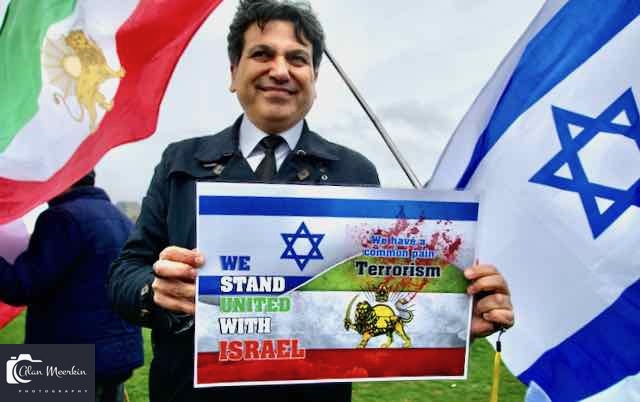
So it was no real surprise when, in Melbourne, I joined the first Jewish Community rally in support of Israel following October 7. It was attended by Jews and non-Jews alike, but prominent among them were Persians proudly holding aloft pre-Islamic Iranian flags. 


Protests and violence against Israel and local Jews sprang up around Australia’s capital cities. Hamas was hailed as a legitimate representative of the Palestinian uprising against colonialist oppressors. Iranians, however, were standing with Israel, shoulder to shoulder. ‘The Ayatollahs are behind it all. They are our common enemy.’ It was heartening to have them with us. 


At that first rally, another man supporting Israel stood in the distance, holding a different flag from an even earlier Persian empire. I would meet him multiple times over the next 18 months and will hopefully discuss him in a later blog post.


London


Months later, I sat quietly with a friend on a train on the London underground, people watching. Opposite us sat a well-dressed woman with a Middle Eastern complexion, and we tried to guess where she was from. Unabashed and unfamiliar with the Tube rule of not engaging strangers in conversation, my friend introduced herself to the woman. The latter was originally Iranian and excited to meet two Jews. She expressed support for Israel in its battle against Islamic extremism in Gaza. I suggested that the innocent Palestinian civilians were victims of tyrannical Hamas manipulation. Her eyes opened wide in response and she raised her voice passionately. “They are not innocent! Every Gazan is a Hamas supporter and wants to kill you all!” I tried to inject a moderate tone into the conversation, but she wouldn’t have it. I was taken aback. Looking around at the other passengers seated nearby, I wondered what they were thinking. Each one remained stone-faced. Then, in that Iranian gesture that was becoming familiar to me, she swept her arm around to indicate the others around us. “They don’t understand what you’re going through. But I do.”


Leeds


Yorkshire is a beautiful part of the UK. I was happy to be invited to Leeds to give a talk on the nuances of life during conflict. On the following weekend, I attended the regular pro-Palestine rally and march in Leeds city centre. It was a very threatening affair. Bystanders watched the marchers take over parts of their town, and one could see the disbelief and disgust in the faces of many locals. No one in the crowd identified as Israeli. No one, that is, except for one, solitary counter-protester, cloaked in an Israeli flag. Arab looking thugs, masked behind kaffiyehs and holding Palestine flags like weapons, approached the fellow threateningly and yelling obscenities. Members of the constabulary stood by, pretending to keep the peace. As an innocent bystander, I watched fascinated, recording everything I saw. Despite the tirade against him, the fellow stood his ground, arguing in Israel’s defence with the masked men in his poor English. His accent was not Israeli, but that did not deter his detractors. “You Israelis are so f….ng dumb. I’m not threatening you,” (said the masked man, nodding to a policewoman for her approval), “but if you join our march, don’t be surprised if you get hurt. Just a friendly warning”. I later watched the counter protester being detained by the friendly Yorkshire police. 


I later made some enquiries with a local contact. Our unidentified counter-protestor, insistent on identifying with Israel in an extremely hostile environment, putting himself at risk, was from Iran. “I don’t know much about him, but he’s a very brave man to face down those thugs”, I was told.


Edinburgh


In the summer of 2024, Palestinian flags hung from apartment windows in Edinburgh, and I found the atmosphere a little disconcerting. 


A major campaign had taken place to designate the coastal neighbourhood of Leith a Zionist Free Zone. 


Much of the graffiti and other hallmarks of the campaign had been cleaned up by the city ahead of the Edinburgh Fringe Festival, but there was still an undertone in the street that was not comfortable. 


Protests took place downtown against Barkly’s Bank for doing business with the ‘Zionist Entity’.  


One afternoon, after an impromptu photoshoot for a hairdressing salon, the proprietor and I got to talking. On hearing I was from Israel, he lurched forward and grabbed me in a bear hug. 

"Bring Alan an espresso and sweets!”, he called to his staff with gusto. Then he turned back to me. ’We are together, my brother. Do you know where I am from? Iran. I managed to leave and now have a good business here.” He motioned to pedestrians walking past his store’s display window, and did that sweeping gesture. “The people in Europe are all stupid. They don’t get us. Iran is creating problems for everybody. I was a well-known stylist for the stars. But I had to leave for a better life. The people there are suffering from the radical Muslims in power. Now Israel is suffering from them. There is much-struggle inside the regime, and real change will only come when the Supreme Leader is removed. When he dies, I believe the regime will fall.” We spoke for 2 hours and, in his thick Farsi accent, my new friend recounted a history of modern Iran under the Islamists, its sponsorship of proxies in Gaza, Lebanon and elsewhere, and internal strife between the various Iranian government members.


I thought of the ignorant Scottish protestors holding Palestinian flags two streets away in front of Barclays Bank, telling one and all that Israel was an apartheid entity, that Hamas atrocities of October 7 were fake, that Gazans were caged into their territory and not allowed to work. 

[I described my encounter with one of the Barclays Bank protesters in a previous blog post.]

https://alanmeerkin.blogspot.com/search?q=barclays


When I spoke with the protester and challenged his accusations against Israel as being contradictory to my first-hand, lived observations, he grew agitated.  “You’ve been brainwashed by the Zionists!” he shouted. 


My Persian hairdresser friend was right. Not only do these people not ‘get it’, but their antisemitic prejudices allow them to be distracted by a fabricated reality. 


During this intense period of history, Israelis and Jews feel gaslit in the face of fake news about their own reality, which they know not to be true. My Persian friends, on the other hand, make me – and all of us - feel both seen and vindicated. 


United Arab Emirates


Earlier this year, I found myself walking through a market in the UAE. 


It was my first trip to the Emirates, and I was amazed at how safe I felt there compared with the Western countries I had travelled to in the previous year and a half. Of course, many Israelis have visited since the UAE joined the Abraham Accords, so as an Israeli I was not a novelty to them. 


An elaborate candy store in the market beckoned. Delicacies of all kinds lined the displays. Some photogenic salesmen caught my eye. When I asked to photograph them, they were initially a little suspicious until I introduced myself. Their faces lit up. “So happy to meet you!”, cried one of them, his eyes gleaming. “I am from Iran.” The man started collecting candies of all sorts for me as a gift. When I refused his offer,  he tried stuffing the goodies in my pockets. 


We didn’t discuss politics at length, but we didn’t need to. Even here, in the midst of the Arabian peninsular, my reception said it all.


Those in the Know vs Those Who don’t want to Know


Persian ex-pats abroad who fled Iran, and the millennials growing up under the Islamic regime, do have first-hand experience of the reality on the ground. Instead of living in a utopian society created by the country’s oil wealth, Iranian citizens have had their money siphoned off. A significant amount of Iran’s GDP has been directed over the years to its revolutionary infrastructure, translated to many billions of dollars to its nuclear program, support for its proxy armies in Lebanon, Syria, Gaza, Yemen and elsewhere, funding for its military and offensive missile programs. And don’t forget the effect of international sanctions on Iran for all the above. This has all been to the financial detriment of Iranian citizens. They are afraid to rise up against the Revolutionary Guards, whose dissenters are imprisoned and tortured, while young Iranian women have been famously beaten to death by government agencies for not wearing a scarf to their liking.

https://www.theguardian.com/global-development/2022/sep/16/iranian-woman-dies-after-being-beaten-by-morality-police-over-hijab-law


Western protestors against Israel ignore first-hand accounts of those ‘in the know’. Their naiveté regarding the challenges Israel faces in protecting itself from extremist Islam seems to derive directly from the liberal Western values that I grew up with. These detractors rely on second and third-hand accounts denying the slaughter of Israelis by and in the name of Palestinians, and they believe stories of a genocide against Gazans by Israel. They lack the nuance to understand the difference between urban warfare and genocide, as well as the patience to research facts for themselves. Unlike the Persians around them, they are blind to any connection between Iran and its involvement in the instability of countries throughout the Middle East. 

https://www.youtube.com/watch?v=dpyrEjeoDLM


They persist in screaming non-sensical slogans, goaded on by their Ayatollah-sponsored friends or prejudiced media, hoping to assuage themselves of the guilt they were taught is theirs for having ancestors who colonised and abused poor, ‘uncivilised’ people in the third world. 

https://sapirjournal.org/friends-and-foes/2024/western-guilt/


As you can see from my description, the factors at play behind these protests are complicated.


But one would do well to listen to witnesses who have seen things with their own eyes. 

Thank God for the Iranian people. I’m glad we are friends.

https://www.facebook.com/share/r/16aS6suxR1/