Wednesday, September 11, 2024

Scotland


Edinburgh, 8.30am local time


On waking, I switched on the Israeli news service.


Israel’s north was pounded by more Hezbollah missiles. More Israeli soldiers killed in Gaza. More rallies calling for the Israeli government to accept any deal to bring the hostages home, even stopping the war; we can continue the fight another day, but no hostage lost is ever coming back. 


I checked my emails. 

A barrage of messages awaited me from loved ones in Israel, sharing links to news about Scotland. When are you coming home, they asked, you’re in danger! The links were to reports that the Scottish Government had sacked its party whip after he had said that, on available evidence, Israel was not conducting a genocide in Gaza. Had it been so, he argued, many more Palestinians would have perished by now. He was berated by colleagues for denying Palestinian suffering. That’s not what he said, of course, but let’s not let the facts get in the way of an anti-Israel campaign. 
https://www.bbc.com/news/articles/c1jlwg8d3lgo

It was time for me to measure the mood on the streets.


Stepping out of the house, I passed the few Palestinian flags that loyal supporters still hang from their windows.


Zionist Free Zone

I made my way to Leith, 20 minutes away on the coast, to meet a Jewish friend who lives and works there. For many years, Leith had a down-and-out reputation. Left wing, woke activists moved in. Yuppies followed, bringing money, expensive brands, and renewal. 


The original hardcore population considered these others to be interlopers, destroying the gritty, indigenous fabric of the town. Over a drink, my friend told me the history of the neighbourhood and the pangs of its gentrification. Since October 7, a vicious campaign advocated making Leith a ‘Zionist Free Zone’. Agitators approached local shop-owners, insisting they display anti-Israel signs in their shops. 

For the sake of his business and his family, he kept his Jewish identity private. But the situation was not ideal by any means. After complaints, and presumably in a bid to remove distractions from the city during the 2024 Edinburgh Festival, most of the anti-Israel posters were removed. Nonetheless, vestiges have remained. 


Apparently local Tory candidate Ian Mcgill, had blue paint splashed on his office facade when he contested anti-semitic and anti Israel activities. Most had been washed off when I passed his office, but smudges remain as testimony to a battle that will surely resurface.


I told my friend of an Arab commentator who emphasised that the West has welcomed-in all those "dregs" of society sidelined by Arab countries. They want to live off the state, introduce Sharia law and seek scapegoats for their troubles. Ludicrously, western democratic countries are importing these troublemakers to be their own next electorate.


My friend pondered a moment. Many strict Muslims live in Scotland, he replied, but certainly not as many as in England. Scotland, he felt, had a better chance than the rest of the UK to hold out against immigrant agitation over the long term, because the Scots have a stronger sense of identity than elsewhere in the country. Food for thought.


The Fringe Festival


Sparks of anti-Israel sentiment made their way into performances at the Edinburgh Fringe Festival.

In one incident, an Israeli couple were abused, both by the performer and by the audience.  


In another incident, a performer banned zionists from his show.


By contrast, London Jewish comedienne Rachel Creeger performed as the Ultimate Jewish Mother. She told me that in her performances, she doesn't shy away from being Jewish. In fact she emphasizes it. Her show is not political, and she tries to impart a positive message. I have seen her show and she does just that. Nonetheless, she has found that since 'October 7', she has been given the cold shoulder by some of her work contacts.  


Of the hundereds of shows on offer, the Festival includer a play called Hagar: War Mother, about a woman fleeing the war in Syria. 


According to the festival website, the solo play is "performed by Amena Shehab, a Palestinian-Syrian-Canadian, a refugee twice over". 

https://tickets.edfringe.com/whats-on/hagar-war-mother


I was struck by the concept of who is a refugee, knowing that this actress was clearly born after 1948 and may have never even been to 'Palestine'. But more so, I was fascinated at how easily the term refugee was used, with reference to someone of Palestinian heritage, as an uncontested fact.


After attending another play at the festival, (a terrible murder mystery!), I chatted with the man seated beside me in the theatre. He knew nothing about the Middle East. Learning of my background, he started asking questions. “Who are Hamas, exactly?”. The more I explained, the less he understood. It was all too complicated. When midnight rolled around, I suggested he watch one of my talks on YouTube and, frustratingly, bade him good night. So many locals hear the rhetoric on the news and see the pro-Palestine marches that block their streets, and wonder what it all has to do with them.


Local Sympathy


Wearing his kippa and dressed in a suit, David Rose goes about his daily business. He confided in me that, in his two decades as rabbi of the Edinburgh Hebrew Congregation, he could count on one hand  incidences when distasteful comments had been made to him for being Jewish. When I accompanied him on the street, making our way through the throngs who had descended on the city for the Fringe, people would stop him to express their sympathies and good wishes for the Jewish community and Israelis. Some were complete strangers.


Between a Rock and A Hard Place


In 2023, Scotland's head of state was Hamza Yousef, a Muslim of Pakistani origin, and the country's first lady was a Palestinian. Her parents were living in Gaza.


On his appointment to the top job, he was accused, in some quarters, of Israel bashing. 

But this did not seem to represent his later conduct.

During his brief time in office, Yousef supported diversity and suggested how Jews should deal with antisemitism.


Following October 7, Yousef attended the Giffnock synagogue in Glasgow, where he expressed condolences to the family of a Jewish Scot murdered in Israel by Hamas on that terrible day.


Yousef resigned his post on 7th May, 2024, for reasons unconnected to his position on Israel.


Now, months later, he is being investigated:

'Scotland's former first minister Humza Yousaf faces probe after quarter-million donation to Gaza

Scotland's former first minister reportedly donated £250,000, out of a fund destined for Malawi, Rwanda, Zambia and Pakistan, only a day before his in-laws were given passage from Gaza'.

https://www.jpost.com/international/article-810318


He must have felt stuck between a rock and a hard place. I don't envy him.


Protests


University protests in Edinburgh were few and far between after my arrival. Students left town for the summer, during which tourists took over the city for the Fringe Festival. The city was clearly cleaned up for the event.


Nonetheless, flyers still decorated windows, advertising fundraising events for Gaza. These were presumably deemed by the authorities humanitarian in nature and not political.


Some political posters did slip through, usually in private windows.


Barclays Bank and the Zionists 

A biweekly protest takes place outside the town branch of Barkley’s Bank. The protestors claim the bank is funding Israeli munitions. 


I decided to attend. About six people, all local Scots, hovered on the pavement around a table with a Palestinian flag.

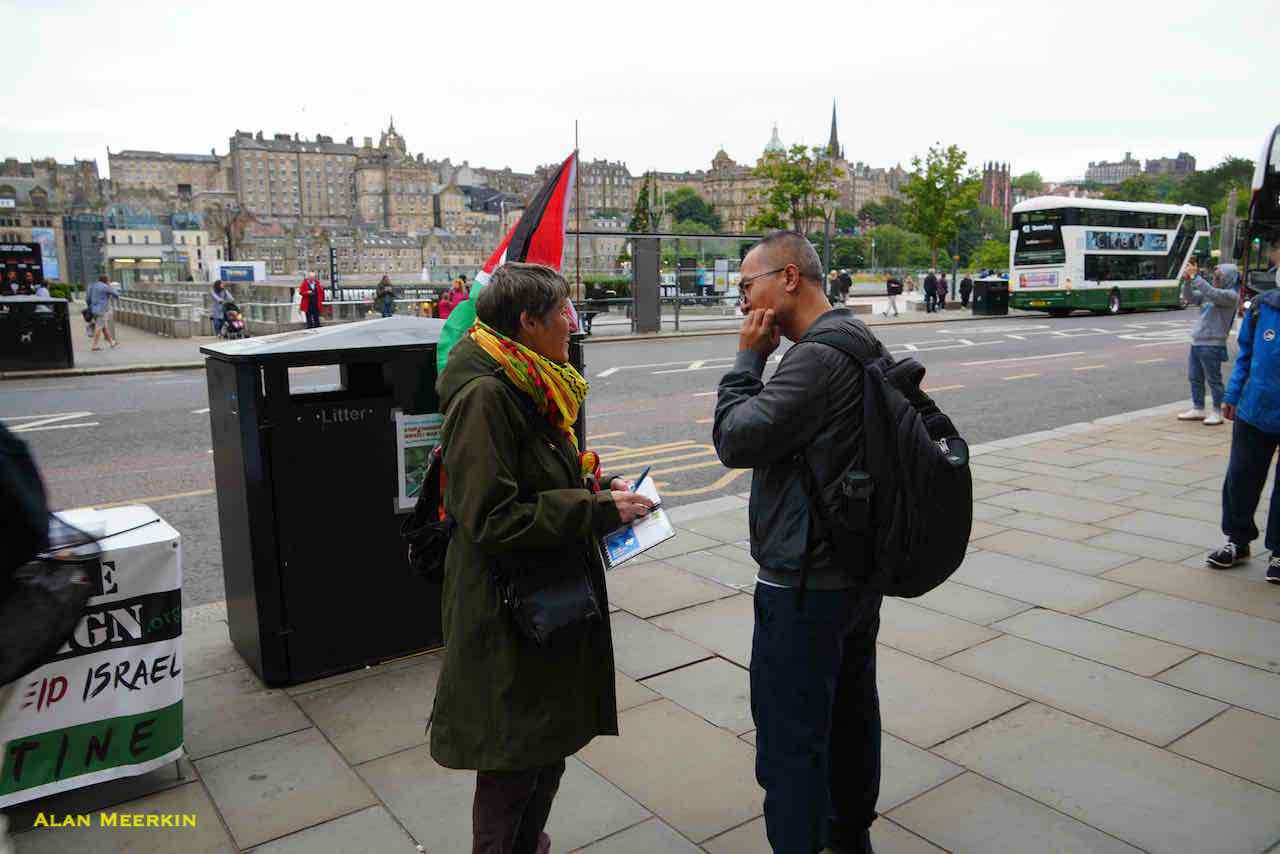

They distributed stickers with the words ‘Boycott Israel’ to the few passersby who stopped. 
All and sundry, including me, were requested to sign a petition against the bank.


The large glass doors to the bank were guarded by two burly security men, ensuring safe ingress and egress for customers. 


I stepped towards the building and they ushered me in. The guards looked serious but sympathetic.

“Do you guys stand at the door all the time, or just when there’s a protest?”, I asked.

“Just for protests. It’s every week.”

“I’m not with them. I’m Israeli", I clarified. "I’m one of those who hides in a bomb shelter when Hamas shoots missiles at us.” The guard glanced at me with a blank, accepting face.

“I don’t get it,” he said, looking out at the protestors. “Some people just want to make trouble.”


One of the protestors outside, wearing an angry expression, approached the doors and motioned for the guard to allow him in.

“Don’t worry, he’s coming for me”, I told the guard who watched, surprised, as I exited the bank to face the protestor’s ire.


“Why are you talking to the Bank’s guards?” he spat at me. “You look like you’re conspiring with the security guys!”

He asked me where I was from.

“Israel”. The man visibly winced with pain.

“Why are you photographing us without asking permission?”

I looked at him, surprised. “You’re in public with a flag and huge signs. I assume you want publicity.”

“Only if you’re with us!”

I spoke calmly, trying to keep the flames low. “I didn’t come to discuss politics, just to see what you’re doing.”

“Do you agree with the Zionists?” he asked me, hoping against hope that I would redeem myself.

“I am a Zionist”, I pointed out, glancing back through the glass doors at the bank’s guards in case I needed protection.


I was immediately subjected to a tirade of misinformation about Israel, apartheid, colonial aggression, land theft, and more. I didn’t push back too hard because, to be honest, no-one was listening, least of all the fellow I was talking to. He was insistent that no atrocities had occurred on October 7, that most Israeli injuries had occurred at the hands of Israel, as cover for its ‘genocidal’ activities, that Palestinians are not allowed to enter half of the country due to apartheid, that all Jews are colonialist immigrants, and more. He was red-faced and close to screaming.

“Why are you being aggressive? This is a civil conversation”. He calmed down, and I continued. “Look, I live in Israel. Everything you're saying is simply not what I see or experience. I’ve been to the burnt out villages near the Gaza border. I work with Palestinians. I even know some who voted for Netanyahu.”


Ach, you have been brainwashed by the ZIONISTS!” His thick Scottish accent and pale complexion somehow exaggerated my sense that his rage was fuelled by white Christian antisemitism, and not by facts. There was no point in continuing our banter, and we both knew it.


I wished him peace and held out my hand. He instinctively took it before realising that I was a ‘Zionist’ and he was shaking hands with the devil.

My thoughts zapped back to my university days, when I sported a kippa and tsitsit. A close catholic friend asked me what a Zionist was. “It’s someone who believes in Jewish nationalism. Why do you ask?” Apparently she had been chided by other students for being friends with a Zionist.


The Church


I was a little shaken by the blind hatred of the protester. I strolled a while to calm myself, before passing a large church. The building was beautiful, and I went in to see it. A community member gave me a tour. 
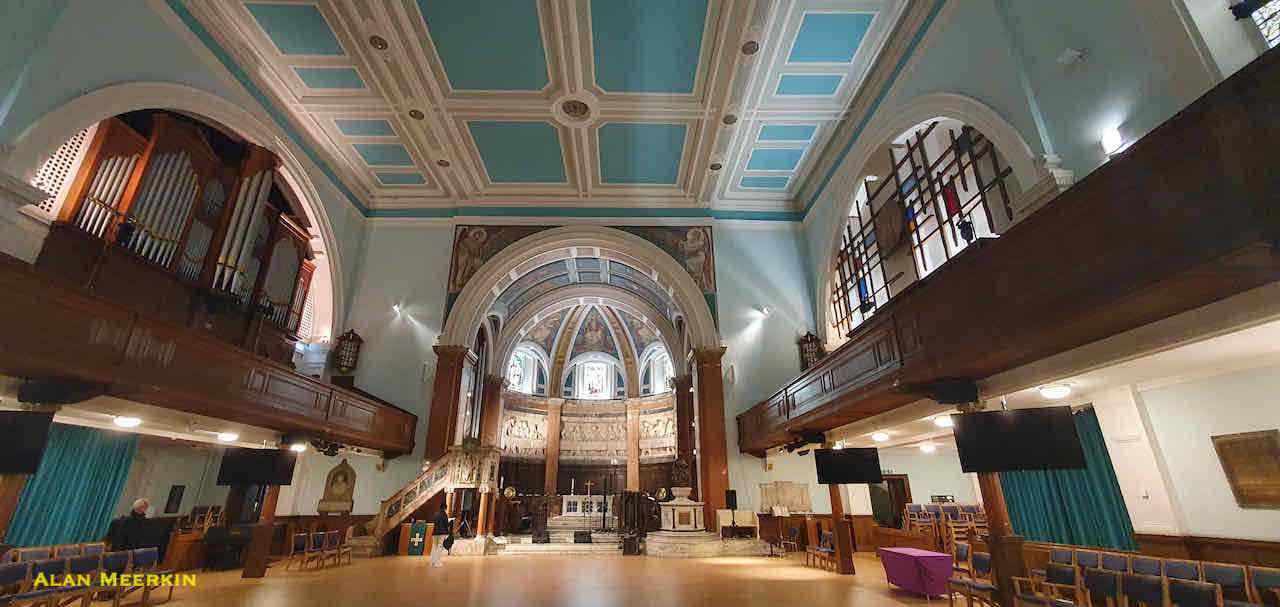


This church is apparently twinned with the Scottish Anderson Church, which is located near me in Jerusalem. I was shown a vintage photograph and I described to my guide what it looks like today.


He had never been to Israel, but, having been married to a Lebanese woman, he had visited Beirut regularly. He shared with me the consternation he felt in the early 1980s when, after the PLO took control of southern Lebanon, snipers started taking pot-shots in Lebanon’s beautiful capital city. I shared with him my experience with the bank protestor only an hour earlier, and we commiserated about the blind, ignorant hatred on the street.


Living as a Jew in Edinburgh

A meeting was held at the EHC synagogue for members to express their feelings about current events. An Israeli woman, living in Scotland for many years, almost cried as she spoke about the distortions in the British media and how it affected the people around her. Following October 7, work acquaintances and others who are aware of her background greet her stone-faced. “Not one of them has said a word, or shown me any sympathy or expressed any interest in my welfare whatsoever.” Others present had similar experiences. 


“Twenty years ago”, she went on, “our son became friends with a boy from a Palestinian family here in Edinburgh. We were so happy they were friends. The other boy’s parents, however, forbade our sons from mingling.”


An elderly gentleman shared his own thoughts. “Local antisemitism is what it has always been. I was bullied here as a wee lad, and it continues today. Don’t fool yourselves. No-one here loves Jews.”


Community Relations with the City


A few days later, the EHC held an annual event marking appreciation for the warm relationship between the Jewish community and the city. With much pomp and ceremony, public dignitaries attended the Saturday service. I stood shooting the breeze with the security guard when one of the event’s organisers came over to the guard.


“Word seems to have gotten out about this event. One of the dignitaries has been stalked and subjected to abuse. For security reasons, he’s decided not to attend today. Everything should be fine, but there’s a small chance that protestors will turn up here. If so, let me know.” No protestors showed, and no-one but the guard, and now you, was any the wiser. But it certainly gave me some insight into the current atmosphere.


During the service, the rabbi took to the podium to deliver a sermon to the community and the dignitary guests. He spoke with sensitivity but in a forthright tone, discussing the values of equality and respect expressed in the bible, which are reflected in the values engendered by the city through the Edinburgh Fringe Festival. Are these values being safeguarded, he pondered? Do all citizens feel respected and safe? Without referencing any specific event or community, he alluded to the agitation in Leith, amongst others.


“We must ask ourselves whether all our residents feel safe, and whether we are doing enough to safeguard and promote those values”. I was proud of the way he raised this issue. At the kiddush and refreshments that followed, the Lord Provost (Mayor) thanked the rabbi for the truth of words and the important challenge they posed.


Ibrahim and Ismail

Numerous Jewish visitors to Edinburgh are hosted by the EHC synagogue for Shabbat meals. During one such lunch, a visitor from Efrat opined that there is no such thing as an innocent Muslim. I was horrified, as was the Rabbi, who is known for his participation in interfaith relations. “The Arabs are children of Ishmael”, the fellow argued, “and he was evil to the core.”

The Rabbi shot back. “Nowhere does it say that Ishmael was evil. In fact he was blessed with being the father of a large nation, today the Muslims.” The rabbi added that when local rabble-rousers had sought to protest against Israel in front of the synagogue, it had been the local Muslim community that had stopped them.


Persians

During the week I entered a store downtown and started a conversation (as always) with the shopkeeper. He was pleased to give me the opportunity to photograph him. We spoke as I got to work, and he shared with me stories of his childhood in Iran. I told him I'm Israeli, and his face lit up, suddenly directing his assistant to make me a cup of espresso. "I support you, man," he said, referring to the current conflict with Hamas in Gaza. "All Persians do. The Jews are our friends, and we respect Israel. The problem is the Iranian government. In the name of Islam, they just shoot people all the time. Also in Iran and also around the world." He told me of family members who still live there, of their economic hardships, of the need to toe the line of the regime. Then he became even more serious and spoke of the country's leaders. Despite that reported in the news, Raisi, he was sure, was bumped off, because he tried to take too much power.  Moreover, the current president is the weakest so far. After him, today's youth will be in a position to wrest back power from the Ayatollas. We looked out the shop window at the passersby, both Muslims and others, and wondered aloud what they think and why. Unlike them, here was a person who understood current world events in the way I understood them. We gave each other gifts, exchanged contact details, and parted.


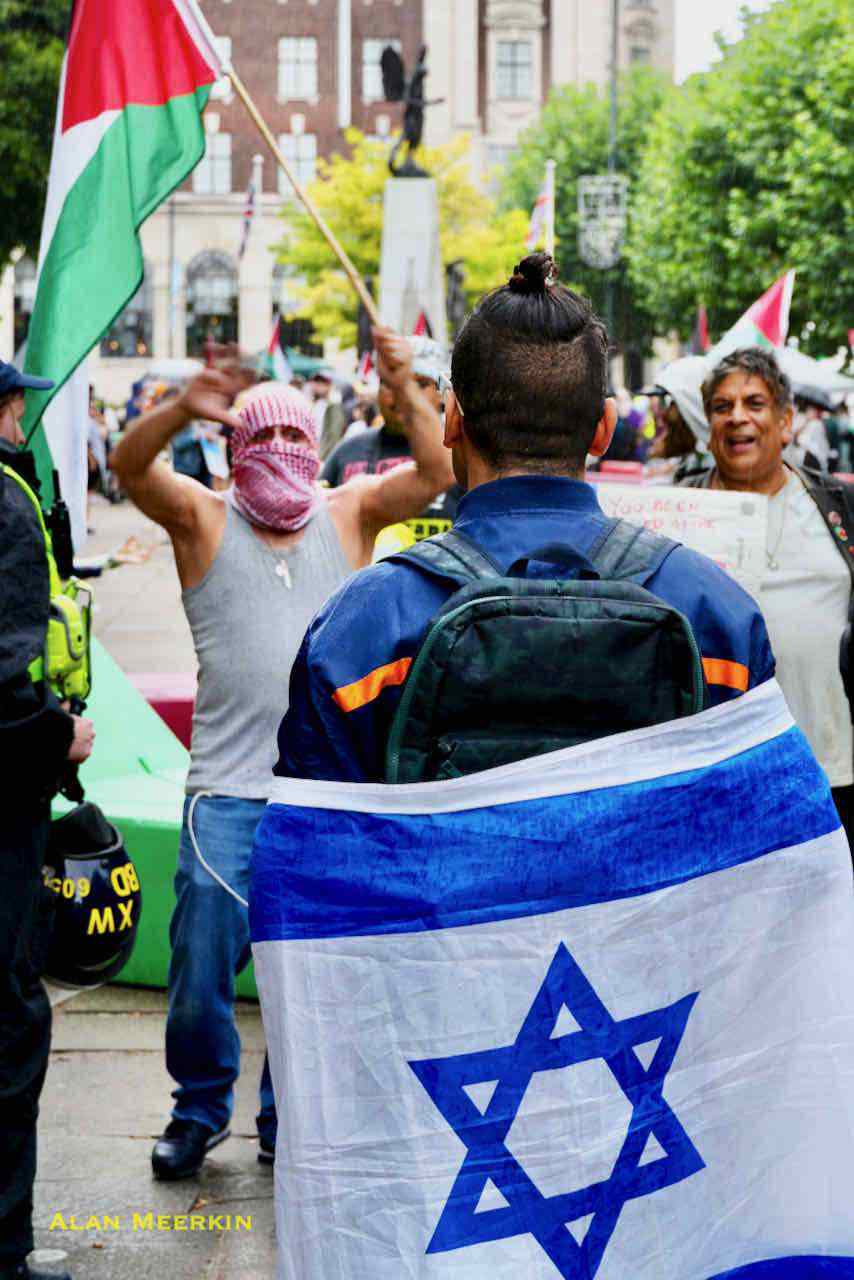
I thought back to other Muslim Iranians I have encountered in the last year. The flag-waving Persians who joined the rally I attended last year in Melbourne in support of Israel; the Persian woman I met on the London tube, who told me rather forcefully (and despite my protestations) that all Gazans are Israel-hating terrorists and need to be finished off; the sole counter-protestor, draped in an Israeli flag, at a pro-Palestine rally in Leeds. This man stood defiant while being screamed at and abused for being Israeli by masked Arabs, who openly threatened him in front of the police. I heard his Persian accent as he retorted calmly, speaking about Hamas atrocities and Israel's right to defend itself. My subsequent enquiries confirmed: this Iranian individual regularly attends these rallies, alone, defending Israel.



The Mosque

The next day, on a whim, I decided to pop into an Edinburgh mosque. I approached the entrance respectfully and the guards allowed me in. Inside it was quiet and serene. I stayed briefly and absorbed the atmosphere. At the exit, I struck up a conversation with some worshippers, and they welcomed me to visit any time. "This is a place of peace. All are welcome.” They spoke to each other in a mixture of Bengali and Urdu.

A worshipper entered and I greeted him. “Salaam Aleikum
Hearing me, the others looked at me in surprise.
“How do you know to say that?”
“I live in Israel”.
“But you’re not a Zionist...right?”
“Actually, I am”, I answered. Surprisingly, the conversation became even warmer.
They hailed from Pakistan, and we discussed the connections between our cultures: Halal and Kosher; modesty and women’s head coverings; the nature of Hashem/Allah; Ibrahim, Yaakub and Ismail.
“We are all cousins, you know”, said one of them with a smile. “Jews and Muslims. We are children of Ismail, you are children of Yaakub.” I nodded.
“What do you think about Netanyahu?” he suddenly asked.
I laughed. But the question was genuine and was not meant as a threat. We spoke for another hour, and we listened to each other with genuine interest.

“It’s a pity you can’t come to visit Israel” I said. “Perhaps one day you will get a UK passport and come to see it for yourself.” We embraced in what I thought was a farewell moment. 


“Please let us stay in touch. We would love to visit Israel.”
My visit to the mosque had led to a small encounter on a big scale. A life situation of which most Scots are unaware, and would almost certainly consider impossible.

I descended the mosque steps and rounded the corner, passing a small, left-wing, social action bookstore, filled to the brim with books advocating for the rights of whom they see as suffering discrimination for their gender, social or political status. 


This included, of course, books about the Palestinians, as well as posters and protest material. 


I flicked through some books and tried to understand.


I did not feel physically threatened in Scotland. It is a very polite and understated society. But as with everywhere else I visited in the UK, the anti-Israel/Pro-Palestine supporters argue 'facts' that differ wildly from what I, as a resident of Israel, see with my own eyes. Why? This is likely due to their sources of information - distorted national media reports and fabrications on social media - combined with a desire to be socially accepted. 


I would be leaving soon, and the summer vacation would end. University students would be returning to their enrolled studies, skipping classes in order to flirt with the cool kids, trying to look trendy and salve their consciences about living affluent lives in a free society. Some might pop into a radical bookstore with material exposing all of society's ills and get riled up by what they see in black and white. All the while, hardworking locals would experience more frustration as the city’s streets are blocked and life is disrupted by marches led by angry thugs, their faces masked by Kefiyes.

It will be interesting to see the the face of the city when the laughter-seeking festival-goers leave their rented student accomodations and the academic institutions get back into full swing. I won't see it. I will be back home, in Israel, hopefully making a difference to the lives of the people around me who live on the front lines. After all, that's where everyone in Israel today is living.


Wednesday, August 7, 2024

A long Time Coming


This blog post has been a long time coming.

After an extended period in New York visiting enterprises supporting Israel and absorbing the current feeling in the Jewish communities there, I continued on to the UK. Every night since then, while dozing in bed after lights out, I have drafted anecdotes in my mind for posting that would explain the view from here. But I have repeatedly put off posting. And with the world changing so rapidly, my anecdotes lose their poignancy by the time I wake next morning.

Last week, Hamas chief Israel Haniya was assassinated, and Iran announced it will exact painful retribution on Israel.

Loyalty to a Cause

Unlike on previous trips abroad, I am following Israeli media instead of local news services. But I also get out to observe the goings on around me. In England, pro-Palestine protests I attended had lost some steam. Many outspoken protesters – woke students who are too lazy to check information beyond social media posts – abandoned their favourite humanitarian cause du jour in favour of a summer traveling the continent. Protests are often like a day at the circus. Hundreds of cool kids and aging hippies, dressed in Kefiyas and tattoos, many adorning watermelon earrings that represent the colours of the flag of Palestine, scream tropes across the road at a dozen pro-Israel counter-protesters stationed opposite, who hold Israeli flags and shout platitudes back at them.


No-one’s listening.

Columns of police stand between them, trying to appear detached and ominous, succeeding at neither. At 5pm everyone goes home, having scratched their itch to ‘do the right thing for humanity’ by taking a political stance.


The Future of England

Some Jewish friends from London tell me privately that they think the golden era of British Jewry is winding down. A new left wing government has been elected, having purportedly purged its blatantly anti-semitic tone. Despite this, five independent candidates were elected primarily on their pro-Palestine stance. When the results were announced, one of them, Shockat Adam, held aloft up a keffiah and proudly called out, “This is for Gaza!”. In Leeds, Mohammad Mothin did something similar. On visiting his constituency of Harehills, I was astounded to see the Palestine flag flying aloft on the municipal building. 


It’s not so comfortable to be openly Jewish here. A couple of people told me that at work they hide their Star of David necklaces and other symbols of their Judaism. Moving to Israel is becoming a genuine consideration.

Others believe this viewpoint is excessive, and the world is going through a rough patch.
And then there are the universalists, who are watching the social disarray around them and fear for the continued existence of western values in this great country.

Protests

In Leeds, riots have broken out against the police on a few occasions. These have nothing to do with Israel, but it reveals a form of an increasingly common form of expression that is anathema to western liberal values.

Protests against Israel have certainly been violent. The one I witnessed a couple of weeks ago was muted as many of the regulars were either on summer vacation, or had been bussed down to a larger event in London. Jewish acquaintances regularly follow on, as masked faces holding green and red flags march through town. The former use their phones to film the protestors for evidence in the event of violence or infractions against the law. This material has led to the prosecution of anti-zionist ill-wishers.

A student chaplain in Leeds, originally from Israel, was called back home for reserve duty in Gaza. On returning to the UK, he was branded by university students as a dangerous murderer. Protestors, at the weekly pro-Palestine ‘circus’, held banners disclosing his identity, slanderously proclaiming that he is armed and dangerous and should not be approached without a weapon. Death threats began rolling in and, soon enough, 24 hour police protection was needed. Left no choice, the young man took his family and fled back to Israel. After the inciteful banners against him were filmed, a prosecution was made.

I attended one of the protests in Leeds to test the mood. As with other protests I’ve seen, the supporters chanted slogans based on facts that can genuinely be called fake news. Nonetheless, the sense of alarm and urgency of the chants, not the veracity, is the motivating factor for these marches.
I spent an hour photographing the event, and at some point told a policewoman that I appreciated her efforts in protecting everyone that day. In Australia I learned that is the done thing; unlike anti Israel agitators, Jews thank the police for their services. The policewoman responded perfunctorily.


“Of course. You’re entitled to protest, aren’t you.” I looked at her with a smile.

“Oh, I’m not protesting. I’m Israeli. A few weeks ago I was in a bomb shelter hiding from Hamas missiles. I’m here to watch and learn. But I appreciate your efforts keeping everyone safe.”

“Just you stay safe”, she responded, before racing off to keep up with the marchers.
I continued taking photos, and those in the march were happy for me to point my camera at them, presumably to give them and their cause exposure.
Soon enough, I felt a tap on my shoulder. An acquaintance with whom I had come motioned for me to leave the crowd. I followed him to a side street.


“The cops are after you. Get out of here.” We hurried off. Apparently the polite policewoman had marked me as a troublemaker, traced me to my friends, and questioned them. I had done nothing wrong, of course, and could easily show my credentials as a street photographer. Nonetheless, I was warned that the police can change their tone quickly, and their sympathies might not be aligned with mine. I have no complaints about the constabulary. I think they were just doing their job. But we made ourselves scarce and spent the day joking that I was a fugitive from the law.


That week I gave another public talk and presentation on the ‘Nuances of Life During Conflict’. Photos I took at the march made their way into my presentation and added to other stories I shared, bringing a home-grown reality to my audience.

A community leader told me, over a coffee, that while non-political activities by the Jewish communities (such as rallies against anti-semitism) are palatable, they should not be pro-zionist. Unfortunately, some people come and unfurl an Israeli flag. The distinction between Jewish and Israeli is very strongly emphasized.

Immigrant City

Later, I joined another street photographer on a jaunt in the nearby city of Bradford. A once wealthy mill town as evidenced by its stunning architecture, is now a residence for Middle-Eastern and Asian immigrants. The dissonance between the stylised, monolithic Victorian buildings and their 21st century inhabitants was striking. 


We strolled the streets with our cameras. Hijabs, saris and gowns, caftans and knitted Rastafarian hats, the pungent smell of ganja and curry, all surrounded us. Scantily clad, pale teenage girls with all manner of piercings, and heavily tattooed adults, contrasted with dark dreadlocked men walking their small children through the city square.


It was a street photographers’ paradise. Being gregarious, I spoke to many of my subjects. Everyone was friendly and, hearing my accent, they often asked where in South Africa I was from. Their surprise at my accent being Australian was only superseded by the revelation that I live in Jerusalem. Israel is a contentious topic, so I prefer initially to say I’m from Jerusalem. One student, from Qatar, looked at me in confusion.

“You know Jerusalem; Al Quds” I clarified for him.

Another local, with Pakistani heritage, had loads of questions for me.

“I’d love to visit Jerusalem some time. Can you tell me about the wall? Where the Jews pray?” The young bearded fellow had a thick accent despite being born and bred in the UK. He asked me about how dangerous it is in Israel. I tried to explain in terms he might understand.

“You know how you see news reports about Pakistan and half the stuff isn’t true? Well it’s the same for Israel.” He smiled knowingly.

Shukran, Ya Habub”, I wished him when we parted.

“What does that mean?”, he asked, explaining that, being a Pakistani Muslim, he doesn’t speak Arabic. He would run it past his Arabic wife.

Driving back to Leeds, we passed neighbourhood shopfronts adorned with Islamic signs: ‘Ahmad Shwarma’, ‘Brides by Noor’, ‘Safa Islamic Lifestyle’, and more. Free Palestine posters littered the walls, but far fewer than I expected.


Tension Under the Threat of Fire

In the evening, I spoke with family and friends back home. This week, in the shadow of Haniyehs death, Israelis are living a double life, going about their daily business and making plans that may be interrupted at any minute by Iranian allied attacks. Close friends in Tel Aviv went for a walk on the beach to let off steam in the summer heat wave. One of our group, a therapist, didn’t join them.

“I can’t do it Alan. I can’t go out into the open and be far from a shelter, exposed.”
Her feelings are totally understandable, especially in the wake of 12 Druze-Israeli children who died two weeks ago playing football, when a Hezbolla missile struck them in their village of Madjdal Shams.

“How are you dealing with the stress?” I asked my friend. She paused.

“I never managed to disconnect like other Israelis. As a therapist I help lots of people who are suffering from the stress these days. I advise them to give meaning to everything they do. And I am trying to do the same. It gives me the motivation to get on with things.”

Some friends are traveling overseas. Others are stranded abroad, as numerous airlines cancelled their flights to Tel Aviv in fear of the turmoil threatened by Iran. Israelis have been advised to make their way to Greece and Cyprus to which Israeli airliners are putting on extra flights to bring people home. Prices on these flights have been capped to prevent gouging. But with a flood of Israelis trying to get to these departure points, connections from other countries have skyrocketed.

A visitor I am expecting next month from Australia called me in a panic. She booked her flights to Israel six months ago, and now everyone is telling her to cancel.

“A month is a long time in the Middle East,” I replied. “Wait and see. No-one knows anything. Except Iran, of course. And possibly not even them. We’re all potential targets, wherever we are in the world.”

I was not telling her anything new, but hearing a calm voice always helps. As long as we stick together, take every day as it comes, and speak in a calm voice, we will get through the current uncertainty.